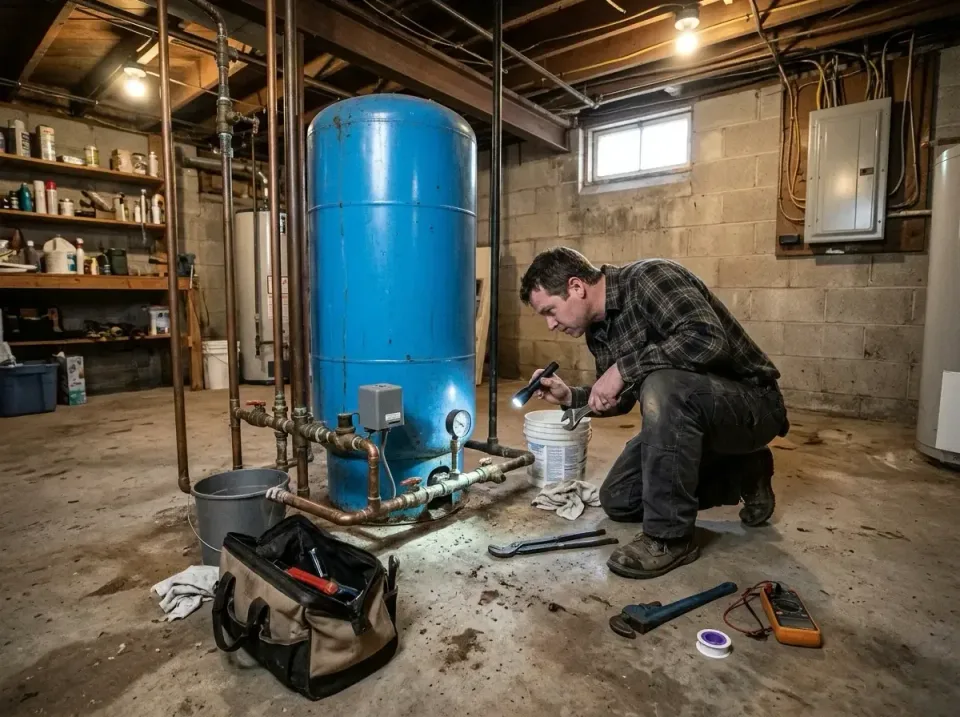
Water Booster Pump Installation
We install residential booster pumps sized to household demand; Colorado jobs typically run $800–$2,500, with pump capacity and electrical work affecting the total. Dry air makes open plumbing work evaporate faster.
When upstairs faucets barely produce a stream, compare them with fixtures on the ground floor before assuming the whole house has a supply problem. If the weakness appears only upstairs, the height and condition of the branch piping deserve attention; freeze-thaw cycles can also stress buried water lines and contribute to broader supply trouble. We start by narrowing down the pattern, not by recommending a pump based on one weak tap.
| What you notice | What to compare | Useful next check |
|---|---|---|
| One upstairs faucet is weak | Another faucet nearby | Clean its outlet screen |
| Several upstairs fixtures are weak | Ground-floor fixtures | Record when the change began |
| Every fixture is weak | Cold and hot taps | Check for a recent supply change |
| Pressure changed after freezing weather | Indoor fixtures and exposed piping | Look for visible leaks without opening walls |
Colorado National Monument gives a familiar regional reference, but homes across Colorado have different pipe routes and elevations. A careful comparison is the quickest useful start.
If the upstairs sink and shower are both weak while downstairs taps run normally, suspect a restriction serving that floor or the added lift to the fixtures. Test more than one upstairs faucet, then repeat with other taps off; this helps separate a local blockage from a system-wide change.
One weak fixture points toward its outlet or branch. Several weak fixtures call for tracing the shared supply route.
Colorado State University is a useful local point of reference for homeowners in Fort Collins, where older and newer properties may have different pipe layouts; do not assume one house’s diagnosis fits another. In homes near Boulder Pearl Street Mall, ask whether the pressure changed gradually or after plumbing work, since that timing helps focus an inspection.
Drought conditions may increase water-conservation concerns, but conservation alone does not explain a sudden upstairs pressure drop. We record which fixtures are affected before recommending a repair.
A pressure gauge can help compare conditions at a suitable test point, but the reading must be interpreted with the fixtures running as well as when they are off. Static water pressure is measured without flow; dynamic water pressure shows what remains while water is moving.
A normal-looking static reading does not rule out a restriction that appears under demand. Do not remove fittings or test an unfamiliar system under pressure.
Flushed sediment and scale can collect after water work or accumulate in older piping, narrowing the path enough to make an upstairs stream disappointing. If the change followed a repair or a shutoff being operated, note that detail.
The Colorado Springs Pioneers Museum anchors a city with homes of varied ages, a reminder that pipe material and past alterations matter during diagnosis. Our crew checks readings and affected fixtures together, rather than treating a single number as the whole answer.
If only one faucet is affected, inspect its removable aerator for grit and confirm the fixture shutoff is fully open. If several fixtures on the same floor are weak, a shared branch restriction or pipe condition becomes more plausible. Keep the evidence simple: note which taps are weak, whether hot and cold behave differently, and whether flow changes when another fixture runs.
University of Colorado Boulder is another recognizable Colorado landmark, while the plumbing in each nearby home still needs its own inspection. A home near Maroon Bells may have a different service arrangement than a city property, so location alone cannot identify the failed part.
Mesa Verde Visitor and Research Center offers a regional reference point for readers in the southwest; there, as elsewhere, flushed sediment and scale may matter if flow declined after plumbing work. We look for a cause before discussing repair options.
DIY checks and call a pro?
Cleaning a removable aerator and comparing fixtures are reasonable homeowner checks. Stop if you see water damage, hear unusual pipe noise, find a leak, or would need to open a wall, adjust a regulator, or work on well equipment. Those steps can turn a manageable diagnosis into a larger repair if the wrong component is changed.
A homeowner near Colorado State University can use the same basic comparison as someone near the Colorado Springs Pioneers Museum: document symptoms, avoid dismantling pressurized parts, and share the timing of the change. During drought conditions, conserving water is sensible, but repeatedly running taps to test them is not a diagnosis.
We explain what readings and fixture patterns indicate, then outline a repair plan before work begins. For more symptom-specific reading, see Why Upstairs Faucets Barely Produce a Stream and What to Check When Water Pressure Suddenly Falls.
If downstairs flow is steady but an upstairs shower stays weak, the right option depends on whether the cause is at the fixture, in a shared pipe, or in the supply. A pump is not the automatic answer. Check the pattern first.
| Option | Best for | Key detail |
|---|---|---|
| Fixture troubleshooting | One weak faucet or shower | A clean showerhead may restore flow when buildup is the cause |
| Pressure regulator repair | Excessive or poorly controlled incoming pressure | Regulators commonly measure ¾–1 inch; they reduce excessive pressure |
| Booster pump installation | Supply pressure that remains inadequate | A constant-pressure booster pump may help when correctly sized |
| Water service line repair | A suspected restriction or damage before the home | Service lines commonly range from ¾–2 inches |
A constant-pressure booster pump aims to keep a quiet, consistent shower flow, but diagnosis should come first. Dry air can make water evaporate quickly from open plumbing work, so a repair area should be protected and left tidy.
Spring snowmelt may raise groundwater around foundations; mention damp areas if service-line access is being considered. Black Canyon of the Gunnison National Park is a familiar regional landmark, but site conditions differ by property. Ask what evidence supports the proposed fix.
Compare fixtures: Run one upstairs faucet and one downstairs, then note whether the weakness is isolated or widespread.
Check the showerhead: Look for mineral buildup that could restrict its openings; avoid forcing parts that resist removal.
Record the pattern: Write down whether hot, cold, or both are weak and whether another tap changes the flow.
Confirm access: Locate the main shutoff and clear a path to the meter or regulator before a scheduled visit.
Protect the work area: Move items away from the pump or piping and protect nearby floors if equipment is present.
Share the timing: Tell the plumber if symptoms began after plumbing work or a cold-weather event; high altitude can increase UV exposure and freeze risk, so mention exposed outdoor piping you can safely see.
Denver International Airport and Denver Union Station are familiar landmarks, but access and scheduling depend on the home, not its proximity to either. Fort Collins Old Town is another local reference; throughout the region, arrive-ready access helps the inspection proceed without moving stored belongings.
Yes, upstairs faucets can remain weak while downstairs fixtures seem normal if a floor branch is restricted or the added height affects flow. A discreet in-home service visit can compare the fixtures and look for the cause; low humidity can worsen indoor static and dust, so keep the work area clear before inspection.
Pressure diagnosis is typically $75–$200, with access and testing time affecting the charge. If the checks point to a regulator replacement, that commonly runs $300–$800 depending on valve size and access; Colorado Plumbing Pros can explain the likely scope before work begins.
Yes, call a plumber if several upstairs fixtures remain weak after you clean the showerhead, or if pressure changes across the whole house. Colorado Plumbing Pros can compare readings and fixture flow without asking you to dismantle pressurized piping; Coors Field is a familiar Denver landmark, but the diagnosis depends on your home’s plumbing.
Denver plumbing permits apply to regulated plumbing work, and the 2022 Denver Building and Fire Code plumbing provisions are relevant to that work. For any excavation, Colorado 811 utility locating must happen before digging; the Denver Botanic Gardens is a local landmark, not a substitute for checking permit and locate requirements.
Yes, if hot water is weaker than cold at the same upstairs fixture, compare another hot-water fixture before concluding the whole supply is low. A Water Pressure Regulator Repair may be appropriate only when testing supports that cause; near Estes Park, low humidity can also increase indoor static and dust, so clear the work area before a visit.
If an upstairs shower weakens whenever other taps run, or several upstairs faucets barely stream, record which fixtures are affected and when the change occurs. Pressure falls about 0.433 psi per vertical foot, so height can contribute to a difference, but a restriction or supply issue may also be involved. Do not adjust equipment blindly.
Aspen Mountain is a recognizable Colorado landmark, and homes across the state face different service conditions; cold snaps can freeze shallow service lines, so report any visible outdoor damage promptly. Garden of the Gods is another familiar reference for Colorado homeowners.
Our Colorado-licensed plumbing professionals diagnose before recommending repairs and explain the options in plain language. For a clear next step, contact Colorado Plumbing Pros at (877) 773-0781 or review our Low Water Pressure Repair service.
Yes, upstairs faucets can remain weak while downstairs fixtures seem normal if a floor branch is restricted or the added height affects flow. A discreet in-home service visit can compare the fixtures and look for the cause; low humidity can worsen indoor static and dust, so keep the work area clear before inspection.
Pressure diagnosis is typically $75–$200, with access and testing time affecting the charge. If the checks point to a regulator replacement, that commonly runs $300–$800 depending on valve size and access; Colorado Plumbing Pros can explain the likely scope before work begins.
Yes, call a plumber if several upstairs fixtures remain weak after you clean the showerhead, or if pressure changes across the whole house. Colorado Plumbing Pros can compare readings and fixture flow without asking you to dismantle pressurized piping; Coors Field is a familiar Denver landmark, but the diagnosis depends on your home’s plumbing.
Denver plumbing permits apply to regulated plumbing work, and the 2022 Denver Building and Fire Code plumbing provisions are relevant to that work. For any excavation, Colorado 811 utility locating must happen before digging; the Denver Botanic Gardens is a local landmark, not a substitute for checking permit and locate requirements.
Yes, if hot water is weaker than cold at the same upstairs fixture, compare another hot-water fixture before concluding the whole supply is low. A Water Pressure Regulator Repair may be appropriate only when testing supports that cause; near Estes Park, low humidity can also increase indoor static and dust, so clear the work area before a visit.
Browse all nationwide service options and choose the right fit for your project.
We install residential booster pumps sized to household demand; Colorado jobs typically run $800–$2,500, with pump capacity and electrical work affecting the total. Dry air makes open plumbing work evaporate faster.
Pressure tank repair covers bladder and connection issues for homes and well systems; typical replacement runs $450–$1,300, depending on tank size and plumbing changes.
We inspect and repair residential pressure regulators, including valve adjustments and replacements; typical replacement runs $300–$800, depending on valve size and access. Aspen Mountain, Cheyenne Mountain Zoo, and t...
Well Pump Repair covers residential pump and control troubleshooting; typical repairs run $300–$1,500, depending on pump type, parts, and access.
Weak faucet pressure repair for homeowners includes faucet flow checks and targeted adjustments; access and fixture condition shape the scope.
We trace sudden whole-house pressure loss, from a pressure reading to accessible plumbing checks; diagnosis cost depends on access and testing time.
Low Shower Pressure Repair addresses weak shower flow, including showerhead and fixture checks; typical jobs run $125–$350, with access and repair scope affecting cost.
We diagnose weak hot-water flow for homeowners, checking fixture passages and hot-side piping; scope and access determine the repair quote.
We locate and repair leaking residential water lines, including buried sections; excavation length and surface restoration shape typical $500–$3,000 jobs.
Low Cold Water Pressure Repair tracks weak cold flow at fixtures and supply lines; scope and access determine the job cost. Snowfall near Pikes Peak can delay equipment delivery.
We clear blockages in residential water lines; typical jobs run $300–$1,500, depending on access and the clog’s location.
We repair corroded residential pipes, including accessible copper sections; typical jobs run $500–$2,500, depending on pipe length and access.
We clear mineral grit and debris from faucet aerators for homeowners; access, screen condition, and replacement parts shape typical $90–$250 jobs.
We replace home water-filter cartridges and housings; typical jobs run about $150–$500, depending on filter type and access.
We clear mineral scale and debris from residential showerheads; typical repairs run $75–$250, depending on access and buildup.
We repair residential water service lines, including buried pipe sections; Colorado jobs typically run $500–$3,000, driven by excavation length and surface restoration.
We repair well pressure switches for homeowners, checking contacts and settings; typical repairs run $150–$500, depending on access and switch condition. Hail near Telluride Historic District can damage exposed equipm...
We repair residential water softeners, including control valves and regeneration components; typical repair pricing depends on system size, parts, and access.
Select a city to find local low water pressure repair providers we cover in Colorado.
Share your job scope for low water pressure repair in Colorado — we will review fit and pricing before scheduling.